
Who couldn’t need a little box that can spit a 120-inch picture onto your wall? That is the fundamental pitch behind 4K ultra short-toss (UST) projectors, which are at times called “Laser televisions.” They’re in fact simpler to set up than customary projectors, and not at all like enormous televisions, they don’t need a gigantic impression. Whenever you’ve put it before a screen (or treated wall), you can call a gigantic realistic picture in a moment.
We’ve investigated a couple of UST projectors throughout the long term, most as of late Formovie’s superb $3,000 model. By and by, I’ve been enamored with LG’s Cinebeam HU85L since we previously saw it in real life in 2019. Indeed, it was costly at more than $6,000, however that was undeniably not exactly the $10,000 prior models cost (and unquestionably better than Sony’s initial eye-watering $30,000 to $40,000 UST projectors). Similar as LG’s most memorable OLED televisions, the CineBeam addressed all that I needed from the fate of home film.
Presently in the wake of putting in a couple of months with the organization’s most recent UST, the CineBeam HU915QE, I’m considerably more fascinated. It’s more splendid than its ancestor, arriving at up to 3,700 lumens with a 2,00,000:1 differentiation proportion, which makes it ideal for daytime seeing and HDR content. (Sadly, it doesn’t uphold Dolby Vision, an interesting component we were shocked to see on the Formovie UST.) The new CineBeam can likewise be pushed considerably nearer to your wall with the capacity to let out a 90-inch 4K picture from 2.2-inches away, or a 120-inch picture from 7.2-inches. I simply wish it was less expensive than $5,000 — with the Formovie unit coming in at thousands less, legitimizing LG’s premium is difficult.
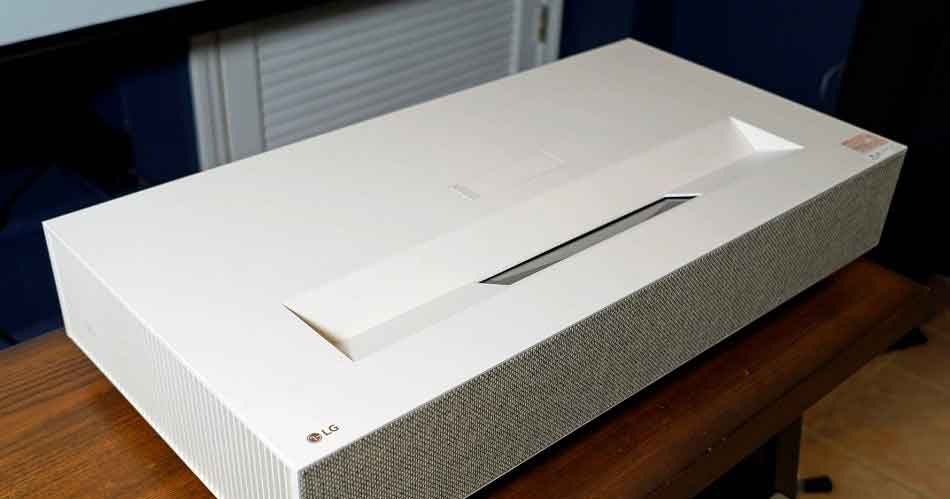
The HU915QE seems to be like most other UST projectors — it’s simply a huge rectangular box — and its plan is essentially equivalent to the past CineBeam. In any case, LG gave it enough pizazz to make it check home in a tasteful family room out. Its front speaker is shrouded in fabric, and the whole unit is encased in a strong light dim plastic. (There’s likewise a dark model for better evening seeing, however that one mysteriously lets out a more obscure picture.) Around back, there are three HDMI ports, 2 USB associations, an optical sound port and Ethernet. It’s not precisely weighty, at 26.9 pounds, however you certainly need a wide table or bookshelf to adjust it to your screen.
That arrangement cycle, incidentally, is surprisingly irritating. Designing any projector is an aggravation, as the need might arise to put it in the perfect spot to fill your screen. With a customary long-or short-toss projector, you’re frequently ready to move the focal point around physically. Be that as it may, designing a UST like the CineBeam includes tracking down the specific level and distance from the screen to make all that look great. On the off chance that it gets prodded by even a millimeter, the picture will essentially look off-base. That makes USTs not so great for homes with little kids or enthusiastic pets. (Additionally, you don’t need kids looking into the projector focal point, as it’s adequately splendid to cause serious eye harm. That is difficult to do with a conventional projector, yet excessively simple when it’s perched on the floor)
At the point when I tried the past CineBeam HU85L, it took me a couple of hours to track down the legitimate situation to work close by my dropdown projector screen. That elaborate purchasing a little table and stacking a couple of wide boxes to get everything adjusted. And, after its all said and done, I couldn’t exactly get the picture to appropriately fill each edge of my screen. That is the point at which I discovered that dropdown screens aren’t great for UST projectors (Engadget’s Steve Mark additionally tracked down that little wrinkles in dropdown screens could prompt undulated pictures). Eventually, I had the option to get the more established CineBeam to fill around 98% of my 120-inch screen, however I abandoned the fantasy about taking care of the entire thing.
Fortunately, I had the option to drop the HU915QE into precisely the same spot as the previous CineBeam. Subsequent to tweaking the manual center wheel a little, it wound up covering a similar region of my screen. In the event that you’re fabricating your home theater or parlor around a UST projector, you’ll preferably need to utilize a tensioned ALR (surrounding light dismissal) screen. Those are worked to hinder light from all over the place yet your projector, and that implies they’ll convey stunningly better splendor and difference. To utilize a UST during the day like a television, you’ll need to drive away however much encompassing light as could be expected.